Showing posts with label vegetable gardening. Show all posts
Tuesday, 14 June 2011
Too Hot for Vegetable Gardening
Here's my harvest of the last couple of days. I am very thankful for ANYTHING. Yesterday, Dallas/Fort Worth reached the 100 degrees F mark for the first time.
We have been having unusually hot weather since before Memorial Day. Normally, the high in early June is around 90 or 91. Also, there is no rain in sight.
Very soon after the heat set in, the lettuce and spinach got bitter. I had to give up on both.
My cucumbers seem to be hanging on nicely, the peppers as well, and I got a few tomatoes. For the tomatoes, though, when the really hot weather hit, they were affected badly. When you have over 95 degree days, tomatoes quit setting fruit.
Also, I planted my tomatoes just a little late in the first place.
I do, however, have good tomatoes, even if they're a little pale. I believe that the Celebrity hybrid turned out the best. I like an acid-y, tangy quality in tomato taste, and mine are great.
I'm encouraged to try again in the Fall. The second go-round of tomatoes begins the last week of July. You put out new plants, which grow rapidly in the hot weather. About the time they are ready to set fruit (September), the nighttime temperatures cool off enough that this is possible. At least in theory! You need everything going your way.
Tuesday, 7 June 2011
All New Square Foot Gardening: The Book That Started it All
How did I find out about square foot gardening? In a roundabout way.
I was looking at posts on a survivalist web forum, and one of the posters said she never thought she'd have the room on her small property to be a gardener -- then she found square foot gardening.
At this point, I became curious. I didn't have any experience, but gardening in small spaces appealed to me. Mel Bartholomew had a program on Public Television for many years concerning this subject. I wonder how I missed that?
So I went to the bookstore, and found the newest version of Barthomolew's book, All New Square Foot Gardening. It seems that, originally, Mel created a system of intensive gardening, but he incorporated the soil in the boxes with the existing dirt space.
That changed with his most recent system of square foot gardening.
Currently, boxes on the ground have layers of weed blocker under them. The boxes are filled with "Mel's Mix", Mr. Bartholomew's custom soil that you mix yourself using vermiculite, compost, and peat moss. None of your property's soil gets into the soil mix. That's the difference between old and new.
But virtually everything else is the same.
In this 271 page book, you'll learn everything you need to know about the SFG system. The author is thorough, patient, and though he's an engineer by training, he never assumes that you know how to do the simplest things. For instance, he gives you lots of pictures and detailed instructions on how to build your boxes. The thoroughness of his work is impressive here.
When he starts talking about various vegetables, their suitability for the SFG system, and how many squares you should plant to feed two people, he's on less steady ground. These are areas of knowledge you will build over time, based on your own observations, abilities, and the unique climate where you live.
But there is plenty here to inspire the most clueless, dumbfounded, purple-thumbed novice gardener. Some of the things that would frustrate the dickens out of a new gardener don't exist in the square foot gardening system. How beautiful.
After more than a year's experience, I still consult this book frequently. It is a wonderful buy for its price.
I was looking at posts on a survivalist web forum, and one of the posters said she never thought she'd have the room on her small property to be a gardener -- then she found square foot gardening.
At this point, I became curious. I didn't have any experience, but gardening in small spaces appealed to me. Mel Bartholomew had a program on Public Television for many years concerning this subject. I wonder how I missed that?
So I went to the bookstore, and found the newest version of Barthomolew's book, All New Square Foot Gardening. It seems that, originally, Mel created a system of intensive gardening, but he incorporated the soil in the boxes with the existing dirt space.
That changed with his most recent system of square foot gardening.
Currently, boxes on the ground have layers of weed blocker under them. The boxes are filled with "Mel's Mix", Mr. Bartholomew's custom soil that you mix yourself using vermiculite, compost, and peat moss. None of your property's soil gets into the soil mix. That's the difference between old and new.
But virtually everything else is the same.
In this 271 page book, you'll learn everything you need to know about the SFG system. The author is thorough, patient, and though he's an engineer by training, he never assumes that you know how to do the simplest things. For instance, he gives you lots of pictures and detailed instructions on how to build your boxes. The thoroughness of his work is impressive here.
When he starts talking about various vegetables, their suitability for the SFG system, and how many squares you should plant to feed two people, he's on less steady ground. These are areas of knowledge you will build over time, based on your own observations, abilities, and the unique climate where you live.
But there is plenty here to inspire the most clueless, dumbfounded, purple-thumbed novice gardener. Some of the things that would frustrate the dickens out of a new gardener don't exist in the square foot gardening system. How beautiful.
After more than a year's experience, I still consult this book frequently. It is a wonderful buy for its price.
Sunday, 30 January 2011
Heirloom Beets
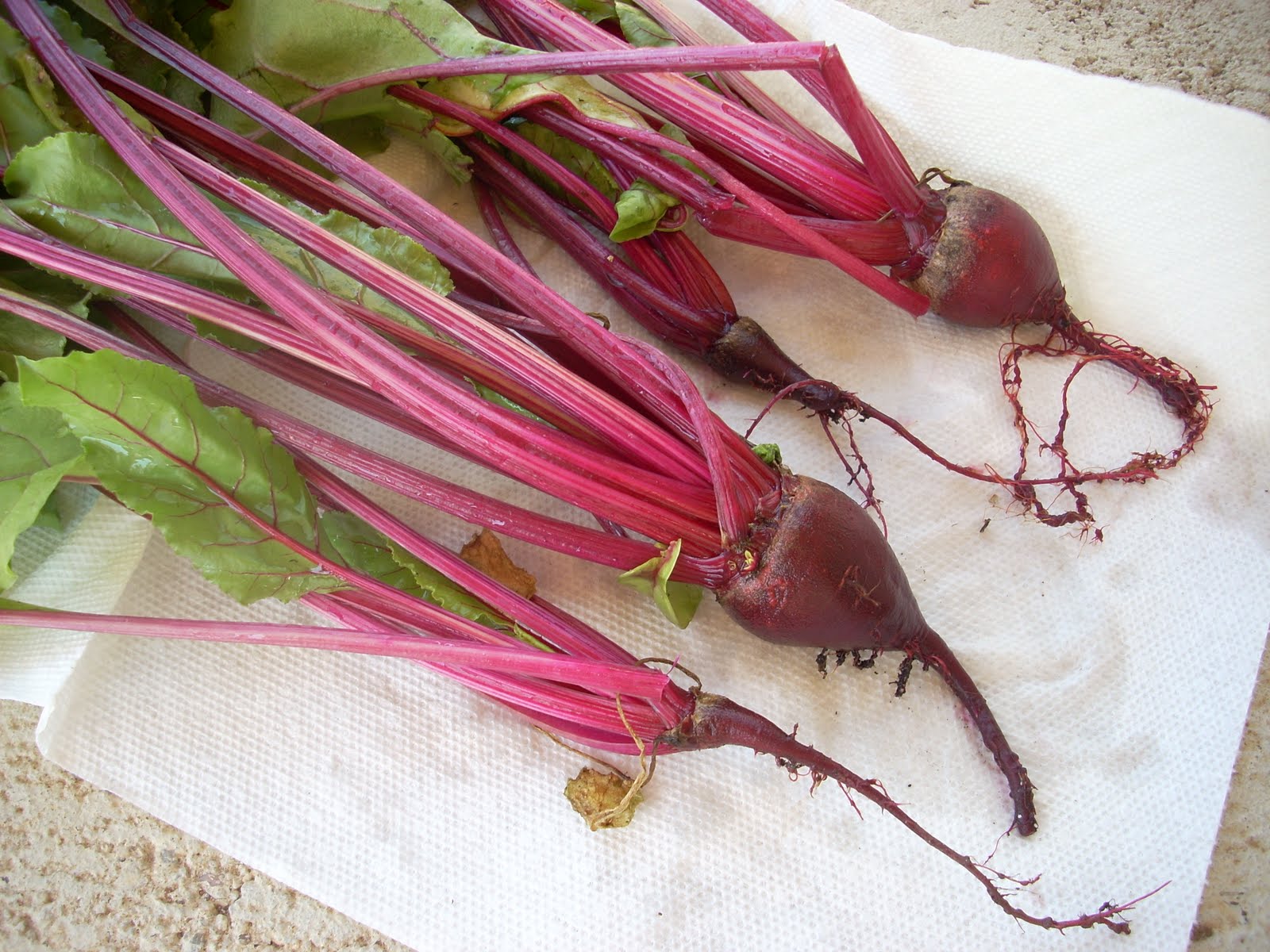
Around the first week of December 2010, I harvested my Detroit Red beets, which I had grown from seed beginning 9/28/10. They were supposed to take 45-60 days, but the roots seemed a little slow to develop, as is so typical for heirloom types. I was advised to wait to harvest close to Christmas, but I knew that wouldn't work for me, so I pulled them up on December 7.
If you look at the below picture of my square foot garden, I had planted 8 squares of beets. And with my harvest, how many servings did I actually get? About 4 to 5. My biggest beets were somewhat larger than a golf ball.
But they tasted very good indeed. They were worth the wait. I'd certainly grow them again, but I believe it would be worth experimenting with hybrid varieties.
I hear you saying, "I'm just too impatient to wait two or three months for beets!!"
I understand, and if you don't like the idea, why not grow the beets simply for their greens? You'll have green tops worth harvesting for a few months, and very quickly, too. If you go this route, this is basically all you'll get from the plants, but it will be the gift that "keeps on giving."
How do you cook beet greens?
Well, you can cook them like spinach, add them to mixtures of other greens like kale or turnip greens, or cook them this way: Add a little olive oil, vinegar, and a small bit of sugar to a saucepan, let it get hot, and add your greens and let them wilt in the saucepan. You can add bits of bacon as well. They are great this way. Or just use bacon grease in place of the olive oil.
Behold, 8 squares of Detroit beets:
Tuesday, 1 June 2010
Broccoli Harvest - Finally!
The Packman variety broccoli transplants were purchased locally and put into the ground around March 7. I ate my first broccoli around April 10.
Fall of 2009, I had grown transplants from seed that I started indoors. They grew huge and beautiful, but that's all. But I fertilized them too much with an organic fertilizer. I found out that by going overboard with feeding them, I gave them too much nitrogen that all went into leaf production.
But, it was worth making some mistakes to reach a milestone. And the broccoli was pretty good. Not great, but decent. I learned that broccoli should be harvested when the heads get about 3 or 4" in diameter, or when the buds on the head get the size of a matchstick's head. I also had some side shoots develop.
This spring the cabbage moths showed up late. I saw my first white moth fluttering around the broccoli around April 29. By that time, my broccoli was all but finished. Sorry! Try your best next time!
Do You Have Time for the Health Benefits of Vegetables?
Friday, 9 October 2009
First Attempts at Growing Broccoli
The Queen of Vegetables
Michael Pollan, in his book In Defense of Food, comments that about half of all the broccoli that goes to the market in the United States is the Marathon variety. Agribusiness finds it necessary to go with the highest yielding, most disease-resistant varieties, which most assuredly means a hybrid crop. How sad that most Americans do not know broccoli as anything other than the big, bright, uniform calabrese types they see for sale in the produce section at the supermarket.
I'm pretty sure that I've never eaten fresh broccoli from a garden. Not from a friend's garden, not from a farmer's market. I hope I have some pleasant surprises in store.
In my square foot garden, I have transplanted a Green Comet variety of broccoli and a sprouting variety -- one plant per square. With the weird weather we've been having in Texas, my first attempt just might prove fruitful. Today it's about 55 degrees F, with high humidity as a cold front has pushed its way from the north, and it's been cool, misty and humid for a number of days in late September/early October. Time will tell, but this seems to be perfect for broccoli's needs. I've had a difficult time doing the hardening off, since we have seen very little of the sun in the past couple of weeks. Finally I decided to go experimental, and just put some of the plants in the ground and see how it goes.
I also have a plant of the Di Cicco (Italian heirloom) variety waiting to put in the ground. In fact, I sprouted three different varieties under lights indoors starting in August. Crossing my fingers....
My article about nutrition is found here:
On the Path to Better Nutrition
Image of a broccoli plant from
Howard F. Schwartz, Colorado State University
Wednesday, 7 October 2009
Re-purposing the Space
New Use for the Filled-In Pool
The ultimate in container gardening! The filled-in swimming pool once held plants, but no more. As of the middle of August, the space now houses a square foot garden, made of 1 X 6 X 8 pine boards and filled with a special soil mix. I removed nearly all the perennials, and laid down weed barrier, then used left-over pea gravel and river rock as a perimeter around my box. The box on the ground is 16 sq. feet (4 feet per side) and has been planted with vegetables, one per square. This type of gardening is called intensive gardening.
Mel Bartholomew is the creator of the square foot garden system. In his world, one lays down wood lathe to demarcate each square.... just like you would do figuratively with a spreadsheet. As a matter of fact, an Excel spreadsheet is the perfect tool to plan a SFG. However, there are some of us who get to the point where we don't want to spend more money. So, my grids have been created using string.
Once the box was planted, I stretched fine nylon tulle over the top, and held it in place with lots of C-clamps. The tulle protects the new seedlings from birds and other interested critters. It provides a degree of shade, too.
Subscribe to:
Posts (Atom)